Ok, maybe the title's a bit of a stretch. I love to travel and venture through different portals of culture, but my return journey from Germany to Italy was just downright miserable.
Everything that could have gone wrong, went wrong.
I missed my first flight, which forced me to take a indirect flight to London. But it was to a smaller airport, which required me to transverse to the other side of the city, via underground, to Gatwick airport.
From there I boarded a flight to Rome. After landing, I took the underground to the Roma Termini, and boarded the last train from Rome to Florence.
It took 3 countries, 3 undergrounds, 3 airplanes, 2 shuttle buses, and freakin' train to get home. Is there any vehicle I didn't use?!?!
I started my journey at about 8am and collapsed onto my bed at a ridiculous 2am.
Plus, I ended up being sick for the next days, but I think that had more to do with feeling the repercussions of the German weather. It was practically Antarctica in Neuschwanstein!
Traveling's fun, only when it goes your way.
Showing posts with label Germany. Show all posts
Showing posts with label Germany. Show all posts
Monday, November 22, 2010

Sunday, November 21, 2010
The Aphotic Past of Germania
When exploring the rich depth of Germany, it's very easy to get wrapped up in its fascinating culture and enthralling tradition.
Yet, it is quite important to chart the entire spectrum. While Germany holds a flourishing past, its time during World War II is one the darkest for the Motherland.
The repercussions of such a period have had a colossus effect on Germany's world reputation and its backlash can still be seen today.
With the final day in hand, we felt it imperative to ingest this important part of Germany's history and more importantly, observe how its had it's effect internally.
We met up with a small group at the Marienplatz (central Munich) for our first tour.


This tour was titled "Hitler's Munich."
Adolf Hitler's rise first began in Munich. After achieving monumental success here, he than furthered his endeavors throughout the country. But the seed was born in Munich.
The basic aim for the guide was to visit key sites in Munich and explore Hitler's climb to power through these specific locations.
Our tour guide was actually British. She's been living in Munich for 30+ years.

The tour took us to a variety of interesting places. Hitler's favorite cafe, art studio, as well as the meeting point for his first revolutionary group:

The above photo is actually from the second floor of the Hofrenbraus!
We also visited key places where important actions turned the tide to Hitler's favor. For instance, we observed a busy square deep in Munich which spurred the first trappings for revolution. In this square, three German soldiers were killed in a gang riot. Hitler used their deaths as means to showcase the lack of authority the current German government held.

There used to be a Nazi plaque below, commemorating the death of the soldiers, but it has since been removed:

We also focused on some of the subtle touches Germany has sprinkled throughout the city that observe the dark period. Interestingly enough, our guide discussed that the Germans do not remember the events in an over-the-top spectacle, but through subtle touches throughout the year that acknowledge the circumstances. Incredibly fascinating...
This monument held a flame inside a chained cubicle. It represents the inability to cage the flame of freedom.

Near the end of the tour, we stopped by two key locations.
The first was the headquarters of the Gestapo in Munich, during World War II:

Alas, it's now become a bank...
The final, was the headquarters for foreign affairs during WWII:

It was here, after Germany invaded Czechoslovakia, that Hitler along with Mussolini, Chamberlain, and Daladier conversed about the effects of Germany's actions. Mussolini, being a master of the languages was able to convince England and France to allow Germany to gain Czechoslovakia. This became known as the Munich Agreement.
When the settlement was resolved, there was a sigh of relief around the world. Having just endured World War I, nobody wanted another war. This agreement would prevent another war from taking place.
Unfortunately, Germany then invaded Poland...
The building is now a school for musical arts.
As our tour came to end, we decided to take a quick break because next tour would be beginning quite soon. This one would involve traveling to Dachau and exploring the infamous concatenation camp found in the outskirts of the town. The Dachau camp was the first concentration camp to be developed and shockingly housed up to 32,000 inmates in its final years.
Dachau is very close to Munich and only requires a 15 minute train ride to reach it.

When stepping off the train, it's almost impossible to grasp it's the nihilistic past. The atmosphere is quite pleasant and simple. It's a genuinely splendid German town. We took a bus to the outskirts of town.

We arrived outside the Concentration Camp to find a carefully designed facility for visitors. It housed a bookstore, cafeteria, bathrooms, and a whole host of utilities for visitors to use, prior to entering the Concentration Camp.
We continued past the facility and soon approached the chillingly entrance to the Dachau Concentration Camp.

Many houses are located just outside of the camp. These houses were used by Nazi officers, along with their family, for living purposes:

While we had the luxury of traveling on bus from the train station, the prisoners were subjugated to unfortunate circumstances. As they would arrive from the train station, they were forced to walk to the camp.
Walking through the front gates and observing the expansive space was quite a shock. Just imagining the trials and tribulations that took place on these grounds was quite unearthly. It was totally quiet and very cold.

This should give you a taste of the expansive isolation:
Dachau Camp
We entered into the first barracks, which held much of the historical information.

We saw some of the instruments of torture:


As well as beams where prisoners were hanged:


Although the prisoners were living under ridiculous sub-par standards, when higher officials would come and inspect the facility, they would be forced to put on a facade.
The German officers would only show the inspectors certain parts of the Camp, along with reassurance that the prisoners were being kept in good condition. Obviously, the prisoners were sentenced to utter silence and were unable to speak against such false claims. The survivors from Dachau claimed that putting on this facade was the most painful ordeal of all. While they were being under-feed, forced to work ridiculous hours in harsh weather, and treated like animals, this false spectacle is what killed them.
We were then led into the farther reaches of the camp.

We observed the Watch Towers, along with the barbed wired that encircled the camp.


This deep ditch covered the surroundings of the camp, making it almost impossible to even reach the threatening fence.

The prisoners were forced to dig the encompassing pit, formed to keep them in. Digging they're own hole.
We arrived to a small bridge.
If the prisoners were miraculously able to make it out of the camp, a river would be waiting them on the other side.

As continued on, we were presented with two dense buildings up ahead.

As we approached the first one, we immediately understood its purpose:

With the death toll steadily increasing, the burning of the bodies was the chosen solution.
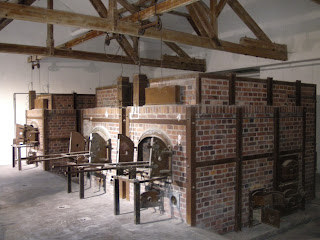

Two bodies could be placed in at each time.

Really dark stuff here, people.
The second building was much bigger.

Dachau was known as the "experimental" camp. They would construct and test out ideas here, and if successful, they would implement them in other camps.
This building was for the development of the gas-chambers.
Oddly enough, the gas-chambers built in Dachau were never used. It's not known why it wasn't put in use here.
Regardless, the construction is exactly how the gas-chambers would be developed.
We saw the compartments where the gas grenades would be thrown in.

We walked through the room where prisoners would change, thinking they were going to shower.
The following sign even reads in German, 'shower.'

Here is the actual shower, along with passages for the poisonous smoke to clear after being used:
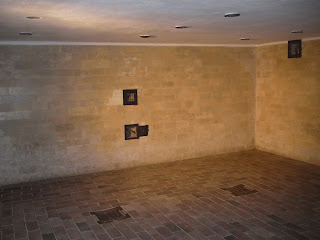
After traveling through the depraved chambers, we escaped into the cool breeze.
And slowly trekked back to the entrance.

Just before leaving, we observed some of the memorials developed for the camp:


The experience of visiting Dachau is two-sided. While on one side, it's uncompromisingly bleak, it provides you with an incredible amount of growth. Your able to understand and experience the trials and tribulations of the this dark period without a glass separating you. Experiencing Dachau firsthand is something documentaries or film cannot provided. Subtle details sprinkled throughout, along with the chilling atmosphere is something only a visit to the camp would provide. Internally, it makes you a better person. Realizing how much the prisoners suffered makes you appreciate your surroundings and develop your future in a new light.
While not an enjoyable episode by any means, it remains an essential endeavor and something I thoroughly recommend experiencing while journeying through Germany.
A memorial that encompasses the fiery culmination of the entire ordeal is what I'll end this entry with:

Yet, it is quite important to chart the entire spectrum. While Germany holds a flourishing past, its time during World War II is one the darkest for the Motherland.
The repercussions of such a period have had a colossus effect on Germany's world reputation and its backlash can still be seen today.
With the final day in hand, we felt it imperative to ingest this important part of Germany's history and more importantly, observe how its had it's effect internally.
We met up with a small group at the Marienplatz (central Munich) for our first tour.


This tour was titled "Hitler's Munich."
Adolf Hitler's rise first began in Munich. After achieving monumental success here, he than furthered his endeavors throughout the country. But the seed was born in Munich.
The basic aim for the guide was to visit key sites in Munich and explore Hitler's climb to power through these specific locations.
Our tour guide was actually British. She's been living in Munich for 30+ years.

The tour took us to a variety of interesting places. Hitler's favorite cafe, art studio, as well as the meeting point for his first revolutionary group:

The above photo is actually from the second floor of the Hofrenbraus!
We also visited key places where important actions turned the tide to Hitler's favor. For instance, we observed a busy square deep in Munich which spurred the first trappings for revolution. In this square, three German soldiers were killed in a gang riot. Hitler used their deaths as means to showcase the lack of authority the current German government held.

There used to be a Nazi plaque below, commemorating the death of the soldiers, but it has since been removed:

We also focused on some of the subtle touches Germany has sprinkled throughout the city that observe the dark period. Interestingly enough, our guide discussed that the Germans do not remember the events in an over-the-top spectacle, but through subtle touches throughout the year that acknowledge the circumstances. Incredibly fascinating...
This monument held a flame inside a chained cubicle. It represents the inability to cage the flame of freedom.

Near the end of the tour, we stopped by two key locations.
The first was the headquarters of the Gestapo in Munich, during World War II:

Alas, it's now become a bank...
The final, was the headquarters for foreign affairs during WWII:

It was here, after Germany invaded Czechoslovakia, that Hitler along with Mussolini, Chamberlain, and Daladier conversed about the effects of Germany's actions. Mussolini, being a master of the languages was able to convince England and France to allow Germany to gain Czechoslovakia. This became known as the Munich Agreement.
When the settlement was resolved, there was a sigh of relief around the world. Having just endured World War I, nobody wanted another war. This agreement would prevent another war from taking place.
Unfortunately, Germany then invaded Poland...
The building is now a school for musical arts.
As our tour came to end, we decided to take a quick break because next tour would be beginning quite soon. This one would involve traveling to Dachau and exploring the infamous concatenation camp found in the outskirts of the town. The Dachau camp was the first concentration camp to be developed and shockingly housed up to 32,000 inmates in its final years.
Dachau is very close to Munich and only requires a 15 minute train ride to reach it.

When stepping off the train, it's almost impossible to grasp it's the nihilistic past. The atmosphere is quite pleasant and simple. It's a genuinely splendid German town. We took a bus to the outskirts of town.

We arrived outside the Concentration Camp to find a carefully designed facility for visitors. It housed a bookstore, cafeteria, bathrooms, and a whole host of utilities for visitors to use, prior to entering the Concentration Camp.
We continued past the facility and soon approached the chillingly entrance to the Dachau Concentration Camp.


While we had the luxury of traveling on bus from the train station, the prisoners were subjugated to unfortunate circumstances. As they would arrive from the train station, they were forced to walk to the camp.
Walking through the front gates and observing the expansive space was quite a shock. Just imagining the trials and tribulations that took place on these grounds was quite unearthly. It was totally quiet and very cold.

This should give you a taste of the expansive isolation:
Dachau Camp
We entered into the first barracks, which held much of the historical information.

We saw some of the instruments of torture:


As well as beams where prisoners were hanged:


Although the prisoners were living under ridiculous sub-par standards, when higher officials would come and inspect the facility, they would be forced to put on a facade.
The German officers would only show the inspectors certain parts of the Camp, along with reassurance that the prisoners were being kept in good condition. Obviously, the prisoners were sentenced to utter silence and were unable to speak against such false claims. The survivors from Dachau claimed that putting on this facade was the most painful ordeal of all. While they were being under-feed, forced to work ridiculous hours in harsh weather, and treated like animals, this false spectacle is what killed them.
We were then led into the farther reaches of the camp.

We observed the Watch Towers, along with the barbed wired that encircled the camp.


This deep ditch covered the surroundings of the camp, making it almost impossible to even reach the threatening fence.

The prisoners were forced to dig the encompassing pit, formed to keep them in. Digging they're own hole.
We arrived to a small bridge.
If the prisoners were miraculously able to make it out of the camp, a river would be waiting them on the other side.

As continued on, we were presented with two dense buildings up ahead.

As we approached the first one, we immediately understood its purpose:

With the death toll steadily increasing, the burning of the bodies was the chosen solution.


Two bodies could be placed in at each time.

Really dark stuff here, people.
The second building was much bigger.

Dachau was known as the "experimental" camp. They would construct and test out ideas here, and if successful, they would implement them in other camps.
This building was for the development of the gas-chambers.
Oddly enough, the gas-chambers built in Dachau were never used. It's not known why it wasn't put in use here.
Regardless, the construction is exactly how the gas-chambers would be developed.
We saw the compartments where the gas grenades would be thrown in.

We walked through the room where prisoners would change, thinking they were going to shower.
The following sign even reads in German, 'shower.'

Here is the actual shower, along with passages for the poisonous smoke to clear after being used:

After traveling through the depraved chambers, we escaped into the cool breeze.
And slowly trekked back to the entrance.

Just before leaving, we observed some of the memorials developed for the camp:


The experience of visiting Dachau is two-sided. While on one side, it's uncompromisingly bleak, it provides you with an incredible amount of growth. Your able to understand and experience the trials and tribulations of the this dark period without a glass separating you. Experiencing Dachau firsthand is something documentaries or film cannot provided. Subtle details sprinkled throughout, along with the chilling atmosphere is something only a visit to the camp would provide. Internally, it makes you a better person. Realizing how much the prisoners suffered makes you appreciate your surroundings and develop your future in a new light.
While not an enjoyable episode by any means, it remains an essential endeavor and something I thoroughly recommend experiencing while journeying through Germany.
A memorial that encompasses the fiery culmination of the entire ordeal is what I'll end this entry with:

Tuesday, November 16, 2010
Disney World! (Not Really)
Traveling outside of Munich, into the Bavarian countryside is an essential endeavor for anyone spending time in Southern Germany.
One of the famous sites in Europe is Neuschwanstein Castle, nestled deep in the Bavarian countryside.
The castle is a majestic piece of architecture, reminiscent of something out a fairy-tale.
Walt Disney formed the now iconic Sleeping Beauty Castle after seeing Neuschwanstein (hence the amazing, alluring, yet falsified title).
Traveling out to Neuschwanstein Castle wouldn't be too much a problem. You'd just need one train and a short bus ride to the towering structure.
We left bright and early at about 8:30 to Fussen.

My mom slept:

And, I scholared myself on the arts at Alte Pinakothek:

While the train ride was quite pleasant, a most eventful change in weather suddenly manifested.
It began to snow.

Not just sprinkle, put properly pour.

We arrived into Fussen to find a blanket of snow.

But, here's the thing. The snow wasn't slushy, dirty, or random.
It was calm, slow, and beautifully sprinkling down. It was one of the most pleasant sights I've ever seen.
We stepped on to our bus from Fussen and began our ascent towards Hohenschwangau, the village beneath the celestial Neuschwanstein palace.
Traveling through the forests and villages was such a phenomenal experience.

The spiring trees, smoked cottages, and snow covered mountains provided one transformative experience. It was as if I had stepped into a Grimm fairy tale.
And this was only the beginning.
While on the bus, we noticed quite a few other adventurers also hoping to visit Neuschwanstein.
The bus arrived and dropped us at the small village of Hohenschwangau, about 2 miles away from the castle.

There are two options available in traveling to Neuschwanstein Castle. You can either hike up there or take routine bus.
Although the weather provided an incredible atmosphere, traveling under such conditions would be quite ridiculous.
To our dismay, we found that due to the hostile weather, the buses were not running. I guess that didn't leave us with much of a choice.
With gloves, scarves, and warm coats wrapped all around, we began our venture.
Opposite Neuschwanstein, is the smaller, older Hohenschwangau Castle. While Neuschwanstein was built by Ludwig II, his father, Maximilian II constructed Hohenschwangau Castle.
While many were heading straight to Neuschwanstein, my Mom and I thought that it would be much more beneficial to experience Hohenschwangau Castle first and then Neuschwanstein. It would be a great companion piece and the perfect build-up.

Fighting through the blistering snow, which had gotten enormously stronger since our arrival, we hiked up the rugged hills toward Hohenschwangau Castle.
The castle is a beautifully nestled in the Bavarian hills and nicely appears as you climb.

The design is lovingly ancient and perfectly rekindles the past atmosphere it was built in.
The view from Hohenschwangau Castle to the lower village is mind-numbingly incredible. Your literally seeped in this ocean of a fantastical world, where fairies, dragons, and knights roam free. Surreal...
View from Hohenschwangau Castle

No video game references this time. The atmosphere and setting found here is not akin to the gaming world. This world evokes the fantastical tales of imagination, lore, and adventure.
We began our tour of the interior of the castle after waiting outside for a little while. No photography is allowed inside Hohenschwangau Castle, so I'm unable to provide a visual representation.
What I can tell you though is that the interior is as a delicately crafted as the exterior. Numerous Germanic frescos cover the halls, filled with stories of classical Germanic folklore.
The furniture and design is everything you'd expect from such a castle. Wooden, carved chairs, large and colorful bedrooms, sprawling Germanic symbols.
The famed composer Richard Wagner was good friends with Maximilian II and actually spent some time in Hohenschwangau Castle. The room reserved for Wagner we visited actually housed the piano he would use to play for the king, as well as numerous personal items from the famed composer.
Other subtle touches were sprinkled throughout the house, such as trapdoors leading to different locations and sacred treasures the royal family kept close by.
Essentially, this was a house fit for a true king.
After experiencing Hohenschwangau, we began our decent down towards the village.

I found the Narnia Lamp post along the way:

But was drenched in falling snow, soon after:

The hike down had some truly angelic moments:


After arriving back to the village, we decided that taking a lunch break would be a splendid option. Just getting out of the sub-zero madness of the weather, which had turned into a ferocious beast, was all I wanted.
While we took our rest at a local place and warmed up, we had a very enjoyable lunch along with the ability to view the beautiful weather without having to actual be in it.

I ordered this very delightful dish:

We also saw this random film crew shooting right outside:

Humorously, they kept re-shooting the scene over and over again. I can only imagine how frustrated their lead must have been to be shooting under such ridiculous conditions. But hey, that's the film business.
Amusingly enough, we also saw numerous visitors just arriving at the village via bus and beginning their venture to the castles. They seemed totally disillusioned by the madness of the weather and were ridiculously under dressed. Fun stuff!
After our break, the time came to tackle Neuschwanstein.
We zipped, buttoned, and wrapped ourselves up before venturing out a second time into the snow-covered landscape.
The trek up towards Neuschwanstein was about twice the length of Hohenschwangau and had a variety of twists and turns. Some quite steep heights as well:


Finally, after freezing to death, we began to see the first etches of the fabled castle.

And oh, was it a sight to behold...

Neuschwanstein Castle
Breathtaking is all I can say to define the atmosphere, scale, scope, and quality of Neuschwanstein.

Surprisingly, even under such harsh weather conditions, many people were still present at the castle. A testament to the quality of the fabled destination.
I recorded some footage of the sublime landscape:
View from Neuschwanstein Castle 1
View from Neuschwanstein Castle 2
Our group was soon call in and escorted into the famed structure.
Akin to Hohenschwangau, no photography is permitted in the castle, but I'll give you my recollected impressions.
The vision for castle is ridiculously ambitious.
As you explore the interior, endless corridors, steep stairs, and stone furniture stand mighty.
Each room is filled with golden statues, mammoth chandeliers, oak fireplaces, and antique arrangement.
The most fascinating thing about the entire scenario, is the fact that each room has its own theme. Ludwig II adored the works of Richard Wagner and thus dedicated each room to a specific Wagnerian Opera.
You step into one bedroom, and sprawling frescos along with even the design of the furniture is sculptured around a certain Wagnerian Opera, be it Lohengrin, Tristan and Isolde, or Tannhauser.
Ludwig II formulated a gigantic hall deep in the castle, intending for musical stages to be performed within the confines of such a space. This epic room was dedicated to the incredibly deep, Parsifal. The depth of Parsifal is incredibly complex, allowing Ludwig II to fill the room with the numerous symbolic touches, sculptures, paintings, and anecdotes, all referencing the epic masterwork.
Essentially, you could call Neuschwanstein Castle an ode to Richard Wagner.
Unfortunately, Wagner was never able to see such an honor. While Ludwig II continuously spoke to Wagner about the development of Neuschwanstein, Wagner died before the Castle could be completed.
It's amazing to see the amount of depth bestowed upon the castle. The patterned archways, swan-like handles (Ludwig's favorite animal), and chimerical appearance, layer Neuschwanstein with that extra sense of fantastical imagination.
Ludwig II was an avid admirer of the fabled world and was able to realize such a fantastical vision through the development of Neuschwanstein. Since its completion, Neuschwanstein has had its own influence on the countless visitors who have made the pilgrimage to the mythical site.
Personally, being able to venture through the fantastical palace and lose all sense of reality for a taste of the fabled illusion, was an unforgettable experience. It's something I will clasp as I continue to explore my own flourishing imagination.
Just before we left, a mini-sized replica of the castle was presented:


As we were escorted out of the castle, back to reality (boring!), we felt oddly out of place.
I helped a group of Asian adventurers with a photograph:

I felt so proud!
As we slowly made our descent from the illustrious castle, we made our final farewell to Ludwig and all his mythical fantasies.

The sights as we spiraled down from Neuschwanstein were gorgeous:


Since the snow had settled down a bit, we were fully able to take in our surroundings, which were truly encompassing.


I captured some absorbing footage of the alluring atmosphere:
Snowy German Forest
We also transversed over a dazzling stream:


Winter Stream
I wonder where it leads to...
We encountered some adventurous Asian explorers trekking up as we reaching lower ground.

Good luck to them!
We finally reached Hohenschwangau village and took the bus back to the Fussen train station.
Here I am, frozen as an icicle, while waiting for the anticipated bus:

Back at the Fussen station, with night rapidly approaching, we really began to feel the temperature decline. It was not a pleasant feeling. Luckily, the train back to Munich was warm and cozy.
Tomorrow, our final day in Germany, would be far different experience. It would be time to explore the darker and more sinister side of Germany's history.
One of the famous sites in Europe is Neuschwanstein Castle, nestled deep in the Bavarian countryside.
The castle is a majestic piece of architecture, reminiscent of something out a fairy-tale.
Walt Disney formed the now iconic Sleeping Beauty Castle after seeing Neuschwanstein (hence the amazing, alluring, yet falsified title).
Traveling out to Neuschwanstein Castle wouldn't be too much a problem. You'd just need one train and a short bus ride to the towering structure.
We left bright and early at about 8:30 to Fussen.
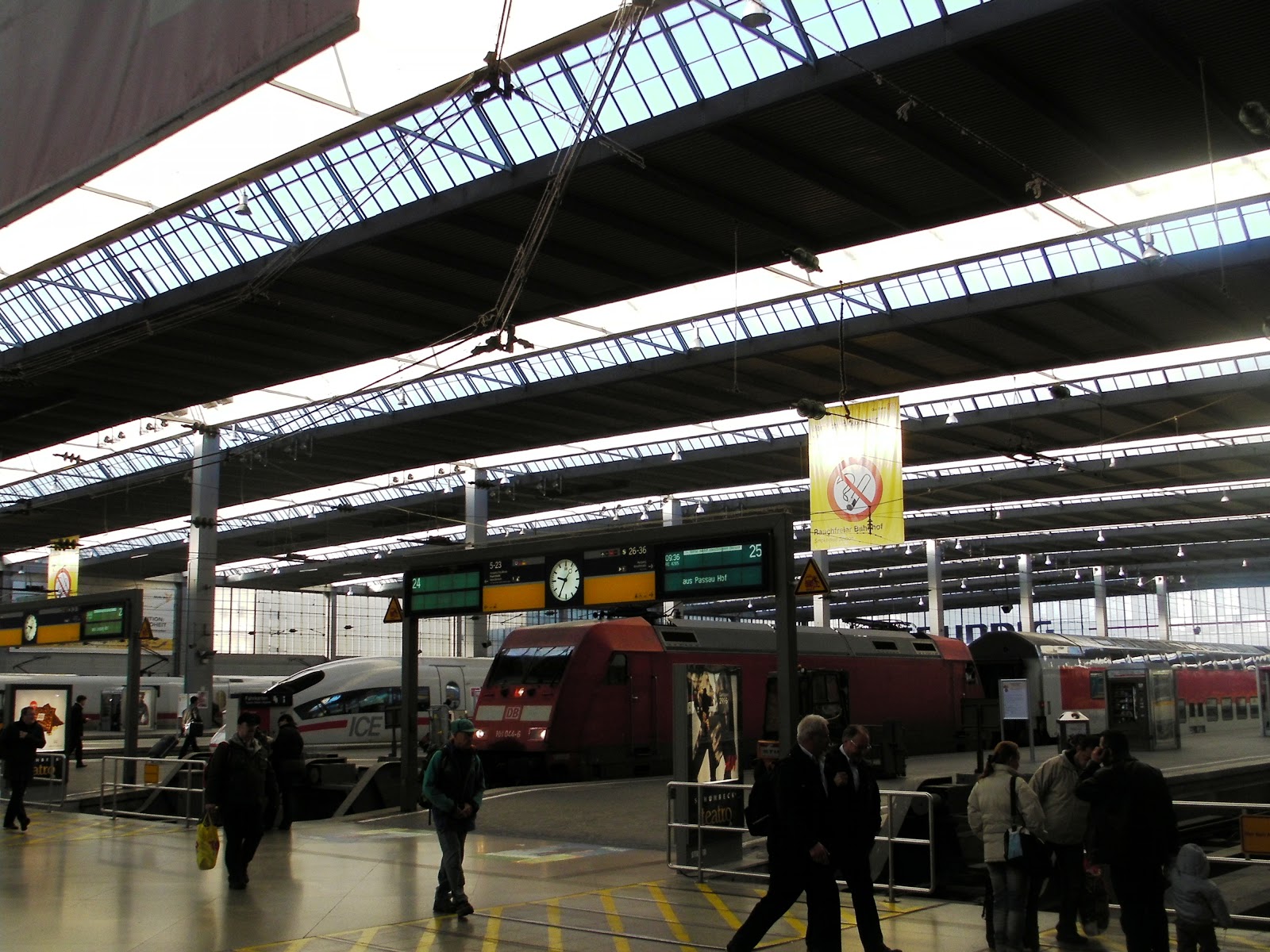
My mom slept:

And, I scholared myself on the arts at Alte Pinakothek:

While the train ride was quite pleasant, a most eventful change in weather suddenly manifested.
It began to snow.

Not just sprinkle, put properly pour.

We arrived into Fussen to find a blanket of snow.

But, here's the thing. The snow wasn't slushy, dirty, or random.
It was calm, slow, and beautifully sprinkling down. It was one of the most pleasant sights I've ever seen.
We stepped on to our bus from Fussen and began our ascent towards Hohenschwangau, the village beneath the celestial Neuschwanstein palace.
Traveling through the forests and villages was such a phenomenal experience.

The spiring trees, smoked cottages, and snow covered mountains provided one transformative experience. It was as if I had stepped into a Grimm fairy tale.
And this was only the beginning.
While on the bus, we noticed quite a few other adventurers also hoping to visit Neuschwanstein.
The bus arrived and dropped us at the small village of Hohenschwangau, about 2 miles away from the castle.

There are two options available in traveling to Neuschwanstein Castle. You can either hike up there or take routine bus.
Although the weather provided an incredible atmosphere, traveling under such conditions would be quite ridiculous.
To our dismay, we found that due to the hostile weather, the buses were not running. I guess that didn't leave us with much of a choice.
With gloves, scarves, and warm coats wrapped all around, we began our venture.
Opposite Neuschwanstein, is the smaller, older Hohenschwangau Castle. While Neuschwanstein was built by Ludwig II, his father, Maximilian II constructed Hohenschwangau Castle.
While many were heading straight to Neuschwanstein, my Mom and I thought that it would be much more beneficial to experience Hohenschwangau Castle first and then Neuschwanstein. It would be a great companion piece and the perfect build-up.

Fighting through the blistering snow, which had gotten enormously stronger since our arrival, we hiked up the rugged hills toward Hohenschwangau Castle.
The castle is a beautifully nestled in the Bavarian hills and nicely appears as you climb.

The design is lovingly ancient and perfectly rekindles the past atmosphere it was built in.
The view from Hohenschwangau Castle to the lower village is mind-numbingly incredible. Your literally seeped in this ocean of a fantastical world, where fairies, dragons, and knights roam free. Surreal...
View from Hohenschwangau Castle

No video game references this time. The atmosphere and setting found here is not akin to the gaming world. This world evokes the fantastical tales of imagination, lore, and adventure.
We began our tour of the interior of the castle after waiting outside for a little while. No photography is allowed inside Hohenschwangau Castle, so I'm unable to provide a visual representation.
What I can tell you though is that the interior is as a delicately crafted as the exterior. Numerous Germanic frescos cover the halls, filled with stories of classical Germanic folklore.
The furniture and design is everything you'd expect from such a castle. Wooden, carved chairs, large and colorful bedrooms, sprawling Germanic symbols.
The famed composer Richard Wagner was good friends with Maximilian II and actually spent some time in Hohenschwangau Castle. The room reserved for Wagner we visited actually housed the piano he would use to play for the king, as well as numerous personal items from the famed composer.
Other subtle touches were sprinkled throughout the house, such as trapdoors leading to different locations and sacred treasures the royal family kept close by.
Essentially, this was a house fit for a true king.
After experiencing Hohenschwangau, we began our decent down towards the village.

I found the Narnia Lamp post along the way:

But was drenched in falling snow, soon after:

The hike down had some truly angelic moments:


We found this sign post, which provided every direction imaginable:

After arriving back to the village, we decided that taking a lunch break would be a splendid option. Just getting out of the sub-zero madness of the weather, which had turned into a ferocious beast, was all I wanted.
While we took our rest at a local place and warmed up, we had a very enjoyable lunch along with the ability to view the beautiful weather without having to actual be in it.

I ordered this very delightful dish:

We also saw this random film crew shooting right outside:

Humorously, they kept re-shooting the scene over and over again. I can only imagine how frustrated their lead must have been to be shooting under such ridiculous conditions. But hey, that's the film business.
Amusingly enough, we also saw numerous visitors just arriving at the village via bus and beginning their venture to the castles. They seemed totally disillusioned by the madness of the weather and were ridiculously under dressed. Fun stuff!
After our break, the time came to tackle Neuschwanstein.
We zipped, buttoned, and wrapped ourselves up before venturing out a second time into the snow-covered landscape.
The trek up towards Neuschwanstein was about twice the length of Hohenschwangau and had a variety of twists and turns. Some quite steep heights as well:


Finally, after freezing to death, we began to see the first etches of the fabled castle.

And oh, was it a sight to behold...

Neuschwanstein Castle
Breathtaking is all I can say to define the atmosphere, scale, scope, and quality of Neuschwanstein.

Surprisingly, even under such harsh weather conditions, many people were still present at the castle. A testament to the quality of the fabled destination.
I recorded some footage of the sublime landscape:
View from Neuschwanstein Castle 1
View from Neuschwanstein Castle 2
Our group was soon call in and escorted into the famed structure.
Akin to Hohenschwangau, no photography is permitted in the castle, but I'll give you my recollected impressions.
The vision for castle is ridiculously ambitious.
As you explore the interior, endless corridors, steep stairs, and stone furniture stand mighty.
Each room is filled with golden statues, mammoth chandeliers, oak fireplaces, and antique arrangement.
The most fascinating thing about the entire scenario, is the fact that each room has its own theme. Ludwig II adored the works of Richard Wagner and thus dedicated each room to a specific Wagnerian Opera.
You step into one bedroom, and sprawling frescos along with even the design of the furniture is sculptured around a certain Wagnerian Opera, be it Lohengrin, Tristan and Isolde, or Tannhauser.
Ludwig II formulated a gigantic hall deep in the castle, intending for musical stages to be performed within the confines of such a space. This epic room was dedicated to the incredibly deep, Parsifal. The depth of Parsifal is incredibly complex, allowing Ludwig II to fill the room with the numerous symbolic touches, sculptures, paintings, and anecdotes, all referencing the epic masterwork.
Essentially, you could call Neuschwanstein Castle an ode to Richard Wagner.
Unfortunately, Wagner was never able to see such an honor. While Ludwig II continuously spoke to Wagner about the development of Neuschwanstein, Wagner died before the Castle could be completed.
It's amazing to see the amount of depth bestowed upon the castle. The patterned archways, swan-like handles (Ludwig's favorite animal), and chimerical appearance, layer Neuschwanstein with that extra sense of fantastical imagination.
Ludwig II was an avid admirer of the fabled world and was able to realize such a fantastical vision through the development of Neuschwanstein. Since its completion, Neuschwanstein has had its own influence on the countless visitors who have made the pilgrimage to the mythical site.
Personally, being able to venture through the fantastical palace and lose all sense of reality for a taste of the fabled illusion, was an unforgettable experience. It's something I will clasp as I continue to explore my own flourishing imagination.
Just before we left, a mini-sized replica of the castle was presented:


As we were escorted out of the castle, back to reality (boring!), we felt oddly out of place.
I helped a group of Asian adventurers with a photograph:

I felt so proud!
As we slowly made our descent from the illustrious castle, we made our final farewell to Ludwig and all his mythical fantasies.

The sights as we spiraled down from Neuschwanstein were gorgeous:


Since the snow had settled down a bit, we were fully able to take in our surroundings, which were truly encompassing.


I captured some absorbing footage of the alluring atmosphere:
Snowy German Forest
We also transversed over a dazzling stream:


Winter Stream
I wonder where it leads to...
We encountered some adventurous Asian explorers trekking up as we reaching lower ground.

Good luck to them!
We finally reached Hohenschwangau village and took the bus back to the Fussen train station.
Here I am, frozen as an icicle, while waiting for the anticipated bus:

Back at the Fussen station, with night rapidly approaching, we really began to feel the temperature decline. It was not a pleasant feeling. Luckily, the train back to Munich was warm and cozy.
Tomorrow, our final day in Germany, would be far different experience. It would be time to explore the darker and more sinister side of Germany's history.
Subscribe to:
Posts (Atom)