What could go wrong?

Tuesday, November 9, 2010

The Deutsch Design

We awoke quite early in Munich. We knew we only had a certain amount of time in Germany, so it was quite important for to use our time wisely.

We had breakfast at nearby cafe titled, Long Fellows. The place was quite awesome, providing some the finest hot chocolate I've ever tasted:


Marching to our first destination, we encountered some rather interesting stores along the way:

We found a Gamestop!


And a random Bollywood store:


We finally arrived at one of the great museums in Munich, the Glyptothek.


The Bavarian King Ludwig I first commissioned the development of the Glyptothek in order to house his collection of Roman and Greek antiquates.


It was fascinating to observe such ancient architecture. How they perceived the anatomy and developed what they considered art.


The Glypothek's main attraction is its extensive amount of sculptures from Temple of Aegina. A small reconstruction of the temple is shown below:


The contrast between the sculptures I'd being experiencing in Italy to the one's I was now observing from Greece was highly interesting. I can now see the Greek influence on the Italian sculptures.


What the Greeks developed in artistic merit through the design of marble, stone, and such material, the Italians took much inspiration from. And with it, perfected the art.


Some very sculptures stood very domineering and quite frightening:


It's unfortunate that many of the Greek sculptures present have been damaged due to age with numerous cracks, chips, and whole blocks missing.


At least, we're able to get a taste of their mastery.


Here I am, getting my philosophical side on with Socrates:


After stepping into a portal to ancient Greece, we turned our sights to the world famous Alte Pinakothek.


Considered one of most revered art galleries, The Alte Pinakothek houses masterpieces from Pieter Paul Rubens, Rembrandt, Raphael, and even Leonardo Da Vinci.

Wandering through the art gallery, I was presented with an ocean of imagination:


The Alte Pinakothek

Some of German painters had some of the most outlandish artworks:


A very epic and inspirational piece depicting a battle of Alexander the Great, stood mightily:


The sense of battle, scope, and scale is staggeringly detailed in this work and its influence can even be seen today in the Warhammer worlds created by Games Workshop.

The Renaissance room displayed some fine works from some notable Italian masters:


The six works of Rembrandt on display were staggeringly incredible. His painting of light is astonishingly striking:


I'd always heard of the mastery of Rembrandt's ability to paint light, but I'd hadn't observed his work until now. I finally understand why he is so revered and cherished. A defining artist that ranks among the finest.


But the most jaw-dropping, mind-blogging, and downright INSANE artist had to be Pieter Paul Rubens. My brother and uncle attended a special exhibition on Ruben's at the National Art Gallery in London some time ago and I remember hearing their overly enthusiastic praise on the Flemish painter. But it wasn't until I experienced his work myself that I've come echo their sentiments.


His ability to craft epic scenes, sprawling across the heights of the room is utterly encompassing.


His paintings don't fail to generic poses that many other artworks fall to. His artwork is always in motion, capturing the intensity and ferocity of the scene.


Here's a panoramic shot I captured of the Ruben's room:

Ruben's Room

The work of Pieter Paul Ruben's is everything painting should be. The ability to capture a moment and encapsulate the atmosphere of the said moment. Just observing at the Massacre of the Innocents, I could hear the screaming, crying, and utter chaos of the rape of the village. Feel the madness bubbling through the canvas and utterly enthralled by the ongoing actions of the characters graphically in action.


Here's a fantastic shot of a Ruben's painting which encapsulates his original sketch (in the foreground) with his final artwork (in the background):


I could on and on about Rubens. He is one of greatest painters to have ever lived and I'm just honored to be able to have observed some of his masterworks in person.


After such an awesome collection of paintings, I picked up a book which covers of the historical and symbolic background of the gallery's most revered works. Should be a fascinating read.

After attending the gallery, we slowly made our way to center of Munich, home to some of the most recognizable places in Germany.

On the way, we stopped by some defining monuments:

 
We also wandered into the English Gardens:


As we explored the gardens we found this gypsy playing a very intriguing tune.

German Gypsy 1

German Gypsy 2

Compare her melody to some of the other ones captured in this blog. Fascinating stuff!

We took a break at a German cafe, where they gave us the longest cake of all time:


We continued deeper into central Munich and observed their intriguing architecture:


Some of the most engrossing architecture lay in the numerous building found within the city:


On the way, we noticed local painter working on some original artwork.


German Painter

I was quite absorbed by his painting. Although he was no master, seeing a painter at work is always engaging.

The most famous church in all of Germany lies in central in Munich, the Frauenkirche:


As we found the Frauenkirche and entered into the church, we found that a Sunday service was in session:


We found some open seats in the back and fully observed the entire service.

It was incredible to experience this from a German perspective. Their pattern, dialogue, and music were very distinguishable in comparison to the English, Italian, or American way.

After attending mass (lol), we stepped out to find that the sun had left us. Though it was freezing in Munich throughout the day, it felt like sub-zero at this point.

This was when we decided the rest our night should spent in a warm environment.

Enter the Hofbräuhaus.


Beer was born in Germany and has since become a national treasure. With it, the development of Oktoberfest has taken place, the world-famous event which includes drinking, eating, and devouring all sorts of things German.

The Hofbräuhaus is the most famous beer hall in the world. It is a national symbol for Germany and houses many of cultural festivities within its wall.

The hearty atmosphere, jolly music, and authentic food, provide visitors with the ideal Germanic experience.

We just had to experience the Hofbräuhaus!

Hofbräuhaus Entrance

I'm no fan of Beer, but I had to devour all things German, since I was in Munich after all.

I ordered their classic beer.


I generally find beer to be of poor quality. I get bloated by it and just find the taste to be quite bland. BUT, the beer here in Germany turned out to be wicked! It tasted like it had life to it!


Even my Mom tried some of it:


The atmosphere around the Hofbräuhaus was fascinating. Every seemed to be having a jolly good time in the beer hall with no frowns to be seen.

The hearty experience at the Hofbräuhaus was awesome. So much so, I purchased an official Hofbräuhaus beer glass, to drink all my Coke Zero in style when I get back home.

Unfortunately, I was unable to finish my drink. Although I tried and tried, the size of the towering mug (it's bigger than my head!) overwhelmed me. At least I got half way!


Feeling quite exhausted after such an extensive day, we headed back to our hotel. We would need to be fully prepared for our adventure to the Bavarian countryside!

Friday, November 5, 2010

Germany!

For fall break (last week of October), we planned out a wicked trip to Germany. My Mom would be flying in from England, while I from Italy. Our excursion would be to the Bavarian side of Germany, the southern region. 

Since my flight was going to be leaving from Milan, I rose bright and early on Saturday and jetted off towards the fashion capital of the world. 

The train to Milan was built into separate compartments, reminiscent of something out of Harry Potter:


After a very LONG 3 1/2 hour train ride, I took a bus shuttle to the Milan International Airport, where I found myself to be shockingly too early. 

I hung around a bit and but really isn't a whole of exponentially cool things to do in an airport. 

After draining way too time on my iPhone, the time arrived to board the first of my two flights. The first one was going to take me to Amsterdam, where I would meet up with my Mom, and then together we would take the second flight to Munich. 

Everything worked out smoothly and we descended in Munich without any problems. The German citizens were extremely polite and helping as soon as we arrived. Their attitude was truly warm and welcoming. 

Two passengers even graciously offered to let their family ticket also cover our trip into the city center. Since a family ticket could amount to five travelers, having my Mom and I travel with them wouldn't be an issue. Very of kind them. 

We arrived at our Hotel at about 10:30pm that evening.  

The next day was going to entail exploring Munich itself.  

Fittingly we took rest, knowing we would need the energy for the forthcoming days in our charting of the Germanic lands...

Tuesday, November 2, 2010

The Five Lands

Considered by many to be one the finest places in all of Italy, Cinque Terre retains a very unique background.

It's situated on the Italian Riviera and consists of five small villages nestled along the sprawling, mountaintop coastline.

Each village has its own distinct characteristic but are united as "The Five Lands."

One of the villages is noted for famously building a wall in order to halt the production of a modern road being built through the village. Surprisingly, they succeeded!

The destination is a defining feature for Italy and attracts visitors from all over the world. Trust me, you'll see why.

Like usual, Saturday was the date. But as I arrived at the train station, it came to my attention that my friend, who was supposedly going to attend with me, for some reason or another, he bailed out.

Oh well...Looks like it was just going to be me and my trusty iPhone to keep me company.

I took an early train to La Spezia, where I boarded a 15 minute shuttle to the first of the five villages, Riomaggiore.

There were quite a few people present as I arrived.


As we climbed up to the coastline, I was presented with some phenomenal views:


The universal procedure in tackling Cinque Terre is basically to hike to each village, one by one. To take in the sights is the whole point, so transversing through the hills is ideal.

There are many different paths to the villages, some more steeper and challenging, while others more leisurely and easy-going.

Since the weather was uneven to the least, many of the more difficult paths were closed off, leaving the general pathway as the only serious option.

Traveling between the first two cities was lovely:


The weather was quite pleasant. A cool and gorgeous breeze would wash over you every once in a while.


I recorded some panoramic footage of the coastline:

Coastline 1

Coastline 2

There was even an adventurous Italian fishing!


Further on, a tunnel presented itself with plethora of graffiti.


After a little more hiking, I finally reached the second village of Manarola.


It was surreal to see these antique buildings situated on the mountainside. You felt that they could fall at any moment.


The design and architecture behind the construction of the villages must have been incredibly intricate.


Within the village, I was stunned by this intriguing sculputre:


And some really gorgeous flowers, blossoming in the most natural viola I've yet to see:


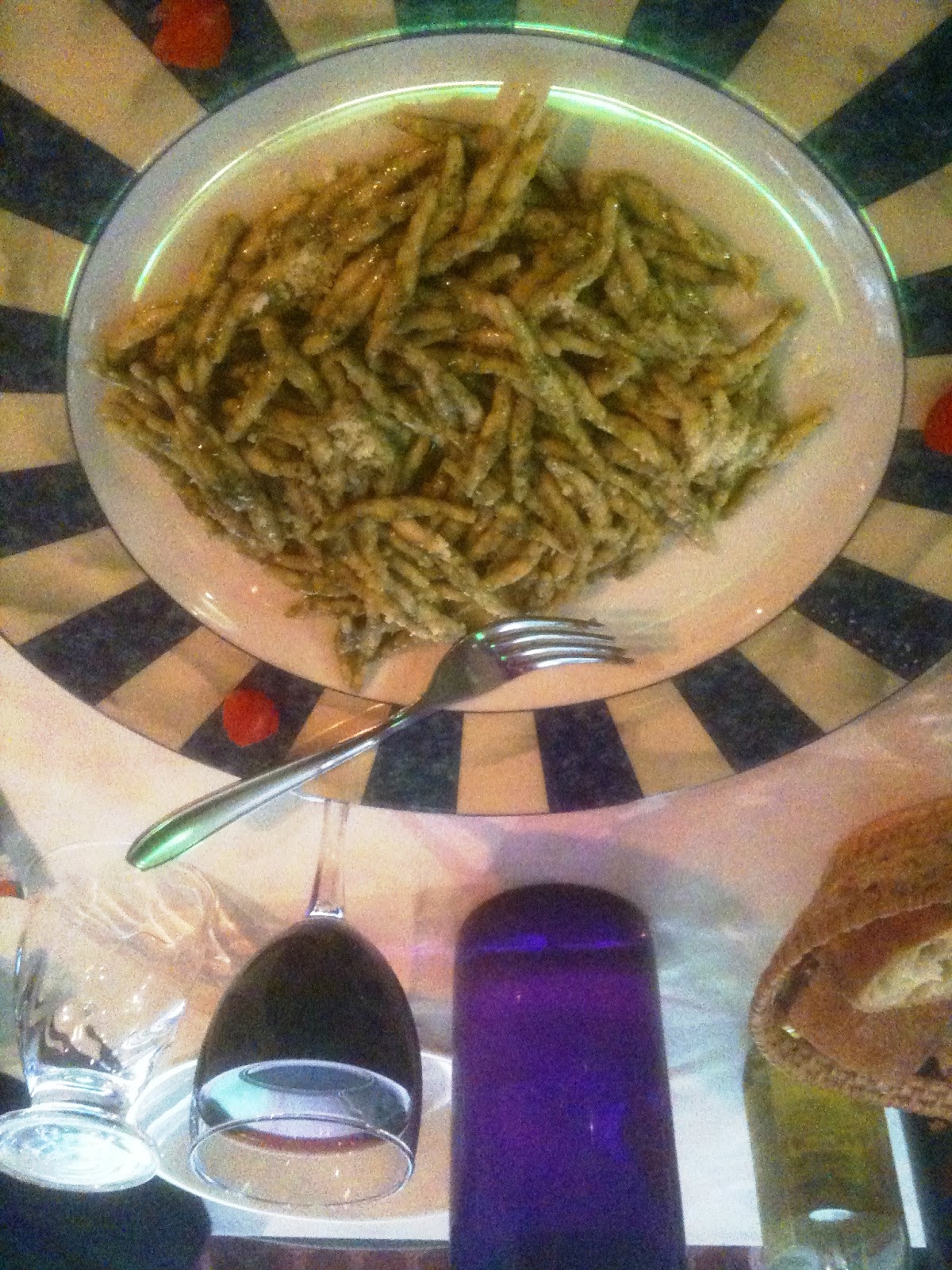
I stopped by for a lunch break in Manarola, where a local dish was served:


Cinque Terre is also noted for its incredible amount of original vineyards, providing some of the finest Italian wine in the country.

I tried out a classical glass of red wine, which turned out to be quite distinguishable.

They get an A+ in my book!

After the break, I hiked up to a higher point in order to capture some of the more impressive sights.


One thing that I kept thinking about was that the villages were built in the same as vein as Brazil's Rio De Janerio. The design, positioning, and patterning of the villages related to the Brazilian city so much.

This thought further reminded of my intense venture in Modern Warfare 2, where you battle through the war-torn streets of Rio De Janiero. Wicked set-piece!

It's really odd that every now and then, when exploring, speaking, or generally philosophizing, I'll randomly equate something to video game culture in some sense. I guess its in my blood...

Anyways, back to the story:


They were so many vineyards!


Here's some footage to give you a better sense of how the vineyards, roads, villages, and mountains stood together:

Vineyards

Towering above the village, the local cemetery lay:


As I turned to view the previous village of Riomaggiore, I was floored by the incredible sense of pattern developing.

To my left lay Riomaggiore:


in the center was Manarola (where I was):


and to my right, Corniglia:


I was wrapped in the rapture of "The Five Lands."

They were all around me.

Only one problem...It began to rain.

Why, oh why?

Luckily, my trusty coat housed a secret compartment which provided me with a very useful hoodie.

I rushed to find cover. Once I did, I looked out and found the scenery to truly awe-inspiring.


While the weather was becoming uncomfortable and really off putting, observing Cinque Terre under such conditions was phenomenal.

It was naturally gorgeous. The mist, rain, and atmosphere were perfectly in harmony.

While I wanted to move forward to the third city, Corniglia, I was informed that the road leading to it was now blocked off.

Luckily, there is a train system which connects the five villages through an underground route. It bounces back and forth every 20-30 minutes.

Since this was my only option, I descended into the underground.

I was greeted by an army of like-minded tourists also wanting to travel to Corniglia in a dry manner.

After what was more like a 40 minute wait, the shuttle arrived. We were all packed in like a can of Tuna and advanced to Corniglia.

As many got off, they all advanced towards the bus shuttle to take them to the center of Corniglia.

If I'm going to visit Cinque Terre, I'm going to properly do it, god damn it! Screw this automobile nonsense!

So I hiked it up there:


Not sure it was exactly the best idea...

Lots of slippery slopes, muddy paths, sharp turns, all wrapped around very steep ascent. Basically an invitation to break your leg.

Luckily, due to my ninja like reflexes and some Assassin's Creed climbing, I didn't.

I was presented with a very gratifying note when I reached the top!


And with it, I explored the third village of "The Five Lands."

Wandering aimlessly through the cobbled, narrow streets of the tiny village, I was given an authentic taste of real Italia.


A balcony was found at the very edge of the village, which provided one of the best vantage points.


The view perfectly put into perspective the entire world around me.

The villages I had passed, the ones I yet to explore. The ocean beneath, the green mountains at level, and the sky above.


I captured some of the encompassing landscape through the lens of my camera:

Landscape 1

Landscape 2

I began to notice that many of the tourists that I had arrived with had vanished. They had all returned to the first village in order to escape the rainy madness of Cinque Terre.

I continued to explore Corniglia for a little more but found that if I spent any more time in "The Five Lands," I'd turn into an icicle.

Although I had only conquered 60% of Cinque Terre, a second journey would have to be in made order to fully chart this side of the Italian Riviera.

I slowly descended to the train station of Corniglia.

I strolled by some fruitful grapes along the way:


I also had an encounter with a couple of French tourists, where I was greeted with a surprising, "bonjour!"


Trying to guess the exact usage of this peculiar looking contraption was impossible:


I think it has something to do with traveling over the vineyards. Sounds so high tech!

I stopped by this very Monkey Island-esque barrel:


Grogg!

I soon arrived at the station and rode the next shuttle back to the first village of Riomaggiore.

I truly adored Cinque Terre. It provided such a distinct atmosphere in comparison to anything I'd experienced before in Italy.

The diversity of Italy is really starting to become apparent. Just look at the blog with some of the places I've visited. You can travel in just a few hours and find a WHOLE new world. Not every country can boast such a claim.

But, you know what the most AMAZING thing about exploring the tropical lands of Cinque Terre was?

Being able to STILL get 5 bars on my iPhone!